Blog
As a consumer, do you feel as if you are able to trust the brands you interact with? The 2018 Edelman Trust Barometer revealed that 52% of the U.S. population does not trust businesses as an institution. Meanwhile, consumer trust has become a controversial topic that is leading brands to further discuss how they interact with their consumers. Contrary to popular belief that brands are not to be easily trusted, many brands are now working actively to establish trust with their consumers. Below are four ways your brand can enhance consumer trust and, in the process, improve the overall consumer experience:
- Stay consistent: Every aspect of your brand should be consistent including your overall message, logo and design, and brand personality. If any of these are inconsistent, consumers may not recognize it, and you risk “losing them”. Using a brand management software like Frontify can be very helpful in staying consistent and organized across all channels. Consistency is a proven strategy that will secure a local brand following while solidifying your reputation as a trustworthy brand.
- Above and beyond customer service: The foundation of any positive personal relationship requires reliability, honesty, and care. The same values should apply for businesses as they relate to their consumers. Showing consumers that your brand cares can come in many different tactical forms, including surveys or questionnaires. Surveys allow your consumers to feel heard and empowered while also showing that you not only value, but require, their opinion. But no matter how you choose to execute your excellent customer service, always remember that a successful and trustworthy brand relationship must be two-way. Your customer needs to see that you give, and not just see you as the only recipient “taking” something in your transactional relationship.
- Be personal: Making your brand feel authentically personal is a great way to gain and keep consumer trust. It must start from the inside: Encouraging employees to be less scripted and “robotic” is the first step to relating in a more personal way with your consumers. To put it simply, always view your consumers as the real people they are – and less like someone you are trying to win over or sell something to. Being more personal is an easy principle to nurture and can quickly change the overall impression of your brand.
- Always be accessible: Making your brand available across all platforms and through different forms of communication is vital. A huge miss for businesses is forcing customers to search exhaustively for contact information. A phone number, email, direct message option, or even an instant chat box should be noticeable and easy to access on any website or social media account. It is also important to remember that not everyone prefers the same line of communication. Therefore, having a phone number ready for the consumer that wants instant answers is just as important as regularly checking your direct messages on social media for the consumer that prefers to online chat. Accessibility will allow your consumers to not only trust your overall brand, but also trust you to give them the highest levels of clarity and communication.

Blog
You’re focused on promoting all the exciting growth and strides your company is experiencing. Everything is trending upwards. Then, in a single moment, without any notice… everything changes.
Are you prepared for when your organization faces a crisis?
Recently, I had the opportunity to present at the Public Relation Society of America’s (PRSA) Communications Symposium at the Ritz-Carlton in Uptown Charlotte. My breakout session, entitled Navigating the Rough Waters of Crisis Communications, provided the audience with several factors to consider before their companies or organizations face a potential crisis. The discussion focused on my experience in the summer of 2016 as the Brand Communications Manager of the U.S. National Whitewater Center, when we found ourselves at the center of media attention on a national and international level… virtually overnight. Among a room of communications professionals, I offered a few key takeaways to help presently prepare their own companies and organizations. I asked them three simple questions:
Who is your team? Know your key players to call on in a crisis situation before one arises. This will simplify the communications process in what will otherwise likely be a stressful period of time for your organization.
Who is your audience? It may sound obvious… but it’s vital. If you can clearly define who you are speaking to, it will help in crafting your message and determining the best mediums for sharing it.
What is your voice? Your organization’s voice does not change in the face of a crisis. Remain consistent with the reputation you have built for yourself. The public will recognize your authenticity and be more open to your message.
Interested in learning more? Check out our recent post on Navigating the Rough Waters of Crisis Communications!
Blog
Writing a press release, posting to social media or landing a speaking opportunity … any public relations practitioner worth their salt should be able to execute these tactics. What separates elite PR professionals from the rest of the pack is creativity and strategic planning. Truth be told, the word “strategy” has been way over stated and under delivered in our industry, so we’re here today to do something about it. Let’s breakdown what an effective and strategic public relations plan should look like.
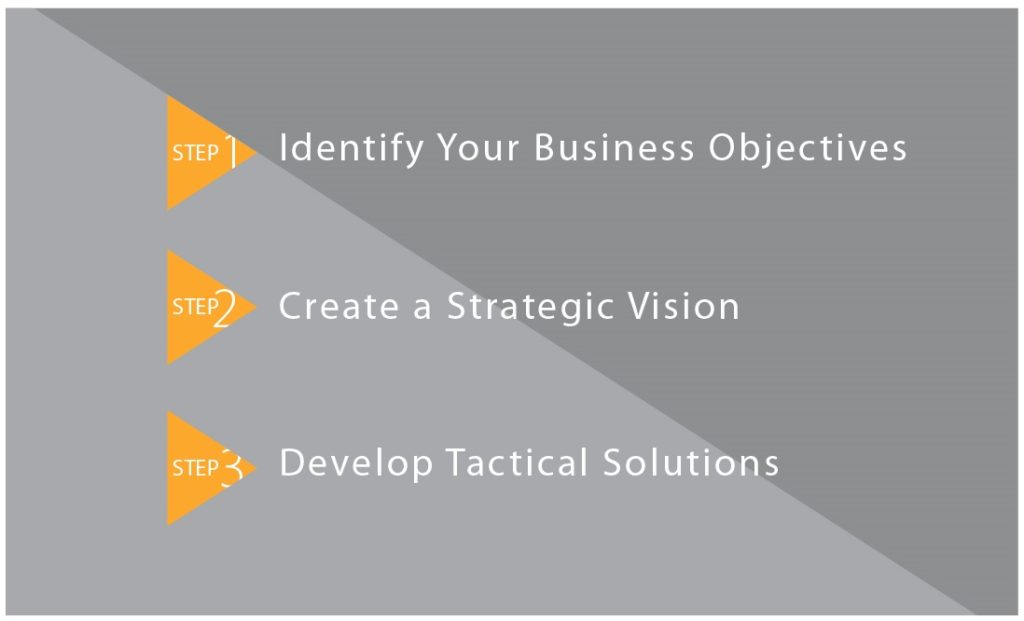
Step 1: Identify Your Business Objectives
These are the pre-determined goals you have for your business as a whole. An example of common business objectives that can be tied to public relations outcomes are customer and employee acquisition/retention, community engagement and public policy.
Example: Employee acquisition- hire an additional 15% to your workforce with a focus on mid to high-level employees that have a strong technology background.
Step 2: Create a Strategic Vision
Only after you’ve defined what your business objectives are can you develop a strategy to support them. It’s oftentimes recognizing the need to build brand awareness, credibility and/or stronger relationships with your various stakeholders. With that information, you should now have a good understanding of what tactics will work best to support your strategy.
Example: Position your organization as the premier technology start-up in your region, where all the top talent can go to be nurtured and rewarded for their efforts. Strong work-life balance and opportunity to “climb the ladder.” Understand your strategic vision should rely heavily upon credibility and corporate culture given your business objective.
Step 3: Develop Tactical Solutions
The devil is in the details. This is the appropriate time to vigorously brainstorm and research how to execute each of the tactics you’ve identified. Create detailed sections explaining exactly what and how you’ll execute for each tactic, such as media/influencer relations, content creation, social media, community relations and partnerships, awards, speaking engagements, crisis communication, brand reputation, policies and procedures, etc. A timeline is also helpful to stay on track!
Example: Keep in mind you should have several tactical solutions to support your vision, but one example would be to research what “Best Places to Work” award opportunities are available within the country’s top technology publications. Poll your existing employees and nominate your organization based on their feedback. Win the award, and in addition to landing a cover-page feature in the publication, you should also tout this accomplishment on your owned media channels and consider paid opportunities surrounding your corporate culture.

Blog
We recently sat down with Charlotte guru Alicia Thomas! She shared with us how her creative process works, and we ended with her thoughts on self-care. Read on to be inspired and to know who to ask about next weekend’s plans.
Tell us what you do:
By night, I am the co-founder of Work For Your Beer (WFYB) with Melanie Fox (who we recently interviewed too, here) and by day I am the Sponsored Content Editor for the Charlotte Observer and its subsidiaries – CharlotteFive, Carolina Bride, and South Park Magazine. As the Sponsored Content Editor, I take a company’s business objectives and turn them into original and engaging content that get their message across without looking like a traditional ads, and still providing value to the reader.
Sounds very creative! How do you tap into those ideas?
At Penn State I studied journalism, and since I graduated I’ve primarily worked in marketing roles — and my day job with The Observer is a perfect blend of the two. I get to write, but I also get to be creative about marketing other businesses to our readers.
The same is true of my side hustle. I’m responsible for all of our content on social media, in our Brewsletter, on our blog and on our website — but beyond that I’m also heading up our partnership efforts so we can work with other cool businesses and get our company in front of an audience that likes what we do and wants to know more.
Luckily, in both my roles, I am surrounded by supportive teams that are very collaborative. When I am stuck or searching for new ideas, they are always willing to help me work through it.
I think it is essential to surround yourself with people who have different skill sets than you, and not to worry about being the smartest person in the room. On both of my teams, we are about collaboration over competition and believe you can learn so much from others’ perspectives, talents and experiences. Learning from others has helped me grow immensely in my career.
When you are working with so many different companies and outlets, how do you collaborate?
We have learned we don’t need to recreate the wheel. Early on, right after Mel and I launched WFYB, we were hosting our own classes — but we soon realized that there were already so many great organizations out there teaching these classes that we didn’t need to add to that. We just needed to be a resource to educate people on their options, so they could get out to all the awesome events that already exist.
And then at CharlotteFive, we’ve occasionally worked with Offline who provides excellent content about events happening in Charlotte. We didn’t feel the need to duplicate their calendar, so a partnership was formed instead.
That’s awesome! What recommendations do you have for companies who want to use sponsored content?
I think one important thing people often forget about is high-quality photography. People are so visual these days, and we are sharing a lot of what we do on Instagram where a great picture can make or break it.
But my biggest recommendation is not to be spammy. The point of using sponsored content over an ad is to engage the customer in an engaging story that they’re going to want to read regardless of whether it is sponsored or not. For example, you’d be much more likely to open an article titled “10 Items Under $50 to Spruce Up Your Home at Target” than something that just says “Spend All Your Money at Target,” right?
When I meet with companies to develop their content, I challenge us to figure out what our readers actually care about, rather than focusing on getting their company’s name in the article a certain amount of times. The goal of the sponsored content pieces I write is to sound like you’re having a conversation with a friend, not like you’re listening to a TV commercial. A lot of times, I think about what I would care about if I were engaging with that company, and I start there.
With two full-time jobs and working around 90 hours a week, what keeps you going and how do you make time for yourself?
At WFYB, one major thing that keeps me going is the feedback we get from our audience. When I get an email saying that someone started working out again because we made it accessible for them or that they were new to the city and found their friend group through the classes, that is really inspiring and heartwarming. It makes us want to keep going knowing we are positively impacting people’s lives.
In general, I always recommend finding an organization system that works for you and sticking to it. I live and breathe by my color-coded calendars (both my Google Calendar and my paper planner). Not only do I keep all my meetings and work reminders on there, but I also schedule time with my fiancé, my friends and for myself to recharge. And most importantly, I honor my personal appointments the same way I would a work meeting. (And here comes her quote to remember…) Don’t prioritize your schedule, schedule your priorities.
And lastly, (most of us) aren’t brain surgeons. So, if a meeting falls through or something gets done later, the world is not going to end, and people are going to understand; don’t get overwhelmed. Take it one task at a time.
From your experience of starting WFYB to growing in your career, what is your advice to others?
If you have an idea in your head, just go for it. Try it and figure out what you need to fix as you go. With WFYB, we didn’t realize that we were a directory until a year and a half in! If we had known that at the beginning, some things might have been easier, but we wouldn’t have learned as much as we did have gone through that process.
And just talk to people! When creating anything, you want feedback from your audience to understand what they truly want and what you can do better. Also, don’t limit it to just your industry. What has been wildly helpful to me and our business is talking to people in all sectors and learning what their goals are and figuring out how we can work together in a mutually beneficial way. As I said earlier, it’s not always the best to be the smartest person in the room — keep learning from those around you.